
Sword Health is reportedly buying Headspace for a fraction of what the meditation app was worth in 2021. It would be easy to read that as one more pandemic-era valuation deflating. I think it is more interesting than that — and the public numbers tell a fairly precise story about why standalone consumer wellness apps don’t hold venture-scale prices.
The End of a Category’s Gold Rush
The news, first: Axios reported on August 26th that Sword Health has agreed to acquire Headspace in an all-cash deal worth between $200 million and $300 million. The deal itself was surfaced by Healthcare Dealflow from a Massachusetts regulatory filing dated July 2026; the financial terms come from Axios’s anonymous sources, not from either company. Neither Sword Health nor Headspace has publicly confirmed anything as of this writing, and the reported close date is September 14th.
Even if those numbers shift, the gap is striking. Headspace Health was valued at roughly $3 billion in October 2021, right after it merged with the teletherapy provider Ginger. If the reported range holds, Sword is buying the whole thing for about a tenth of that — a ~90% compression in headline equity value in under five years.
Headspace was not a bad company that got overvalued. It was a genuinely good consumer product that raised money at a price the underlying business was never structured to justify — and the reset to a few hundred million is the market re-pricing the asset for what it always was.
How Headspace Built the Category
Headspace’s app launched in January 2012, grown out of a London events company that booked a former Buddhist monk to run meditation sessions. Clients wanted something to take home; the team built an app to give it to them. That accidental-product origin turned out to matter, because the thing they built was unusually well made.
The product decisions from that era are now standard playbook, but Headspace was early to most of them. Meditation was reframed from an intimidating spiritual practice into a friendly, low-commitment habit: short guided sessions, a single calm narrating voice, the round orange mark, progress streaks to pull you back the next day.
The marketing leaned on borrowed credibility (early partnerships with Virgin Atlantic and Harvard, later a meditation series on Netflix) rather than pure performance ad spend. On top of that sat a clean, high-margin B2C subscription: pay annually, get the whole library.
It worked. Headspace passed 1 million paid subscribers in 2018, up about 50% in a year, and picked up commercial customers like Google and LinkedIn along the way. Revenue went from an estimated $30 million in 2016 to $100 million in 2019 to $150 million in 2020 as the pandemic drove people toward anything that promised calm. Together with Calm (its near-twin, also founded by UK entrepreneurs, always somewhat larger) Headspace didn’t just compete in the consumer mindfulness category. The two of them defined it.
The Pivot to Clinical Care
By 2020 the B2C engine was showing its limits. Consumer meditation is a finite market, and the people most likely to pay for it had largely been reached. So Headspace did what a lot of maturing consumer apps do: it went looking for enterprise money and for a bigger story to tell.
The enterprise move was to sell Headspace as an employee benefit (an add-on to the wellness and EAP packages that HR departments already buy). The bigger story arrived in 2021 with the Ginger merger, which combined Headspace’s self-serve meditation app with Ginger’s on-demand therapy, psychiatry, and behavioral coaching. The combined entity, Headspace Health, was valued at $3 billion. The pitch was a full spectrum of mental healthcare in one place: open the app to meditate, and if you need more, escalate to a coach, a therapist, a prescriber. All under the same brand, sold to employers and health plans as a single contract.
On paper it addressed a real problem. Benefits buyers in 2021 were drowning in single-purpose point solutions and wanted fewer vendors covering more ground. A meditation app that could also route someone into clinical care was a better answer to that than a meditation app alone. The question the merger didn’t resolve was whether one organization could actually run both a software subscription and a clinical practice well at the same time.
What the Numbers Did Next
Four years of data are now in, and they do not describe a company growing into a $3 billion valuation.
Start with the top of the funnel. Sensor Tower’s estimates put Headspace’s worldwide app installs at a peak of about 4.8 million in Q4 2018 — and every year since has been lower. By Q2 2026 the app was pulling in roughly 980,000 installs a quarter, an ~80% decline from that peak. The drop began well before the Ginger merger and has not reversed once.
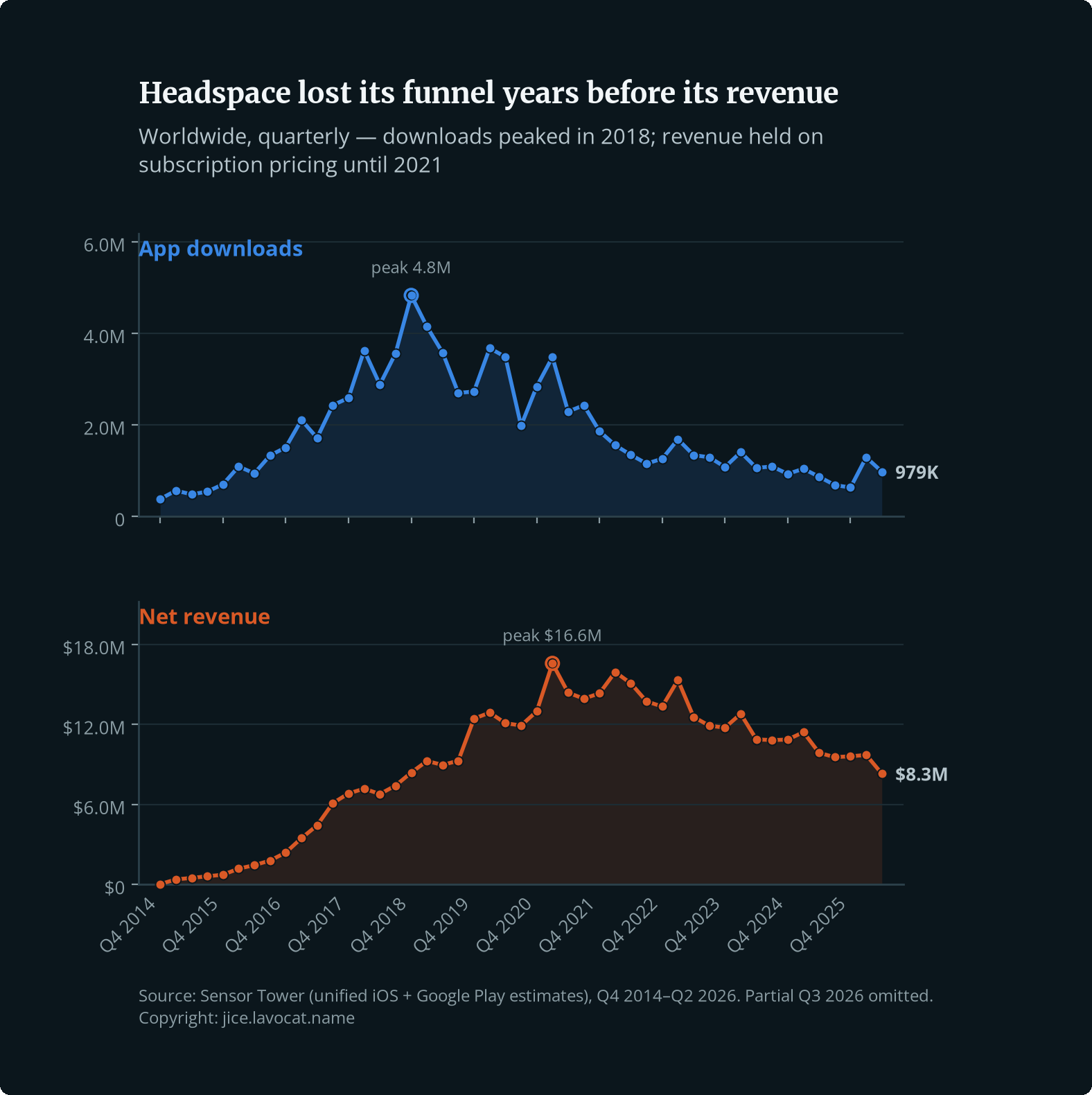
Revenue held up much longer, and that gap is the whole story. Sensor Tower’s app-store revenue estimate for Headspace kept climbing through the download decline (subscription price increases and a growing paid base offset fewer new installs) and didn’t peak until Q1 2021, at about $16.6 million in a quarter. Since then it has fallen to roughly $8.3 million in Q2 2026, a ~50% drop. On a full-year basis, Sensor Tower has app-store revenue going from about $59 million in 2021 to $40 million in 2025.
The one line that kept climbing was the B2B logo count. Headspace’s number of commercial customers went from about 420 in 2019 to 5,000 in 2025, per Business of Apps — roughly a 12x increase.
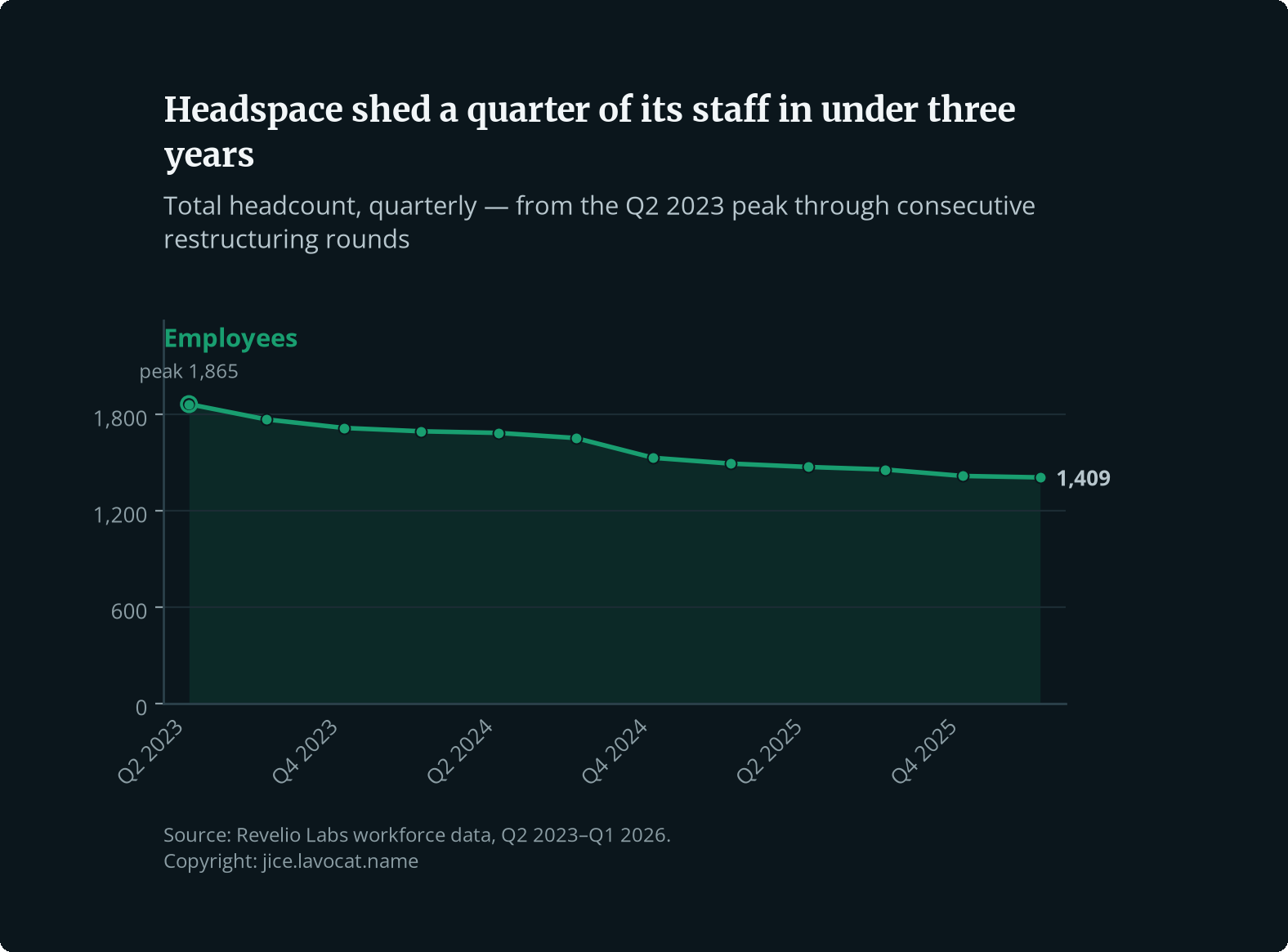
Underneath that, the cost structure moved the wrong way. Running Ginger’s clinical side meant carrying therapists as salaried headcount — labor that behaves nothing like software gross margin. The restructuring record reads accordingly: about 4% of staff cut in December 2022, then 181 people, roughly 15%, in July 2023, then about 13% in November 2024, alongside a move to shift the therapist network to part-time and contract roles. Workforce data from Revelio Labs puts the shape of it plainly: headcount peaked around 1,865 in mid-2023 and has come down almost every quarter since, to roughly 1,410 by early 2026 — a ~24% reduction in under three years, with the sharpest single drop between Q3 and Q4 2024.
The therapist-network change is the clearest admission of the underlying problem: converting W2 clinical labor into a variable cost is what you do when the blended margin of “meditation plus therapy in one app” hasn’t worked.
Post-pandemic consumer churn, rising acquisition costs, an enterprise business that added logos faster than dollars, and a clinical operation that dragged on margin — those pressures ran concurrently, and they compound.
Why Sword Health Is Buying
For Sword Health, the logic is clean.
Sword is an AI-driven virtual care platform that started in musculoskeletal (MSK) physical therapy and has been expanding outward, one clinical area at a time. Its product line now spans Thrive for pain care, Pulse for cardiometabolic health, Bloom for women’s health, and — as of 2025 — Mind for mental health, which pairs an AI therapist with a wearable and on-call clinicians. Sword was last valued at about $4 billion (June 2025), with a reported revenue run rate around $240 million, and its CEO has publicly tied a planned 2028 IPO to getting the mental-health offering right. Headspace slots directly into the newest and least-proven of those four lines.
Against that, buying Headspace for a reported $200–300 million in cash buys several things at once:
- A front door. Headspace is one of the most recognized consumer health brands in the world, with something like 85 million lifetime installs. That is a triage and engagement surface — a familiar interface people will actually open — that Sword can use to route users toward its higher-acuity physical and mental care.
- Content and distribution. Headspace’s mindfulness library is training data and product surface for Sword’s conversational-AI care. Its 5,000 employer and health-plan relationships — including large payers — are enterprise distribution Sword would otherwise spend years building.
- A competitor removed, and an IPO de-risked. Folding in an established behavioral-health brand strengthens the story Sword wants to tell public markets in 2028, and takes a potential rival off the board in the process.
The reported price looks low only if you anchor to 2021. Anchor instead to what the asset does for a $4 billion acquirer with a $240 million revenue base, and a few hundred million in cash for the brand, the installs, and the enterprise book is a rational distribution buy. The observers calling it a distressed multiple and the ones calling it a bargain are describing the same number from two different reference points.
This isn’t the first deal of this shape. In July 2025, Universal Health Services bought Talkspace for about $835 million — another 2021-vintage digital behavioral-health name, acquired well below its peak by a care operator that wanted the consumer front end for its inpatient network.
The Takeaway: Point Solutions Get Consolidated
A pure-play consumer subscription app is valued at a consumer-subscription multiple. A platform valuation needs one of two things: multi-product enterprise integration deep enough that you are effectively a broader company, or AI-driven leverage that delivers a service at software-like margins. Headspace reached for the first through the Ginger merger and found that a clinical practice inside a consumer-software org drags margins toward care-delivery economics, not up toward SaaS. Sword is betting on the second. The rest of the 2021 cohort that raised at platform prices on consumer-app fundamentals is working through the same reconciliation now — a few will find a real multi-product motion, more will get absorbed into someone else’s platform at a reset price, and very few will compound to billions alone, because that was never the shape of the business.
The math a board runs on a $3 billion company is the math I run on a $30,000 app: what is the organic top of the funnel, what does it cost to replace a churned user, and is there any margin left after you deliver what you promised. Headspace’s numbers answer the first question clearly, and the reported price is what that answer is worth. The open question is who is next — and whether every one of these assets finds a platform to belong to.
References
- Axios Pro (2026) — Scoop: Sword Health to acquire Headspace for up to $300M. First report of the deal financials ($200M–$300M, all-cash), from anonymous sources.
- Behavioral Health Business (2026) — Sword Health and Headspace: A Strategic Deal With Broader Market Implications. Deal analysis, the valuation-question framing, Sword CEO comments on IPO and behavioral-health M&A, and comparable transactions.
- Behavioral Health Business (2026) — Filing Reveals Sword Health’s Plan to Acquire Headspace.
- Sensor Tower — Unified (iOS + Google Play) worldwide quarterly download and net-revenue estimates for Headspace: Sleep & Meditation, Q1 2012 – Q3 2026. Retrieved August 2026; source for the download/revenue chart and the quarterly figures in “What the Numbers Did Next.” Store revenue only — excludes enterprise/health-plan contracts billed outside the app stores.
- Business of Apps (2026) — Headspace Revenue and Usage Statistics. Source for the total-company revenue, subscriber, commercial-customer, valuation and funding series (figures after 2020 are estimates).
- Behavioral Health Business (2024) — Headspace Axes 13% of Workforce, Transitions Therapist Network to Part-Time and Contract Roles.
- Behavioral Health Business (2023) — Virtual Mental Health Provider Headspace Health Lays Off 180 Employees.
- Revelio Labs — Headspace quarterly workforce headcount, Q2 2023–Q1 2026 (via Latka). Source for the headcount chart.
- Sword Health — product pages: Thrive (pain care), Pulse (cardiometabolic), Bloom (women’s health), Mind (mental health).
- TechCrunch (2025) — Sword Health nabs $40M at $4B valuation, pushes IPO plans to at least 2028.
- Sword Health (2025) — Sword raises $40M and launches Mind, AI mental health care.
- The Hemingway Report (2024) — From Meditation to Medicine: What’s Been Happening at Headspace?. Case study on the B2C-to-B2B DNA mismatch.
- WIP Design Studio — How Headspace Became a $320M Brand with Great App & UI Design. On the early product-led growth and UI decisions.
- Digital Health Wire — Sword Needs Some Headspace. Market commentary on the acquisition rationale.
- Insurance Business (2025) — UHS and Talkspace close $835 million deal linking virtual therapy to inpatient behavioral health. The comparable strategic-acquirer transaction referenced in “Why Sword Health Is Buying.”
- Behavioral Health Business (2026) — SUD Falls Short While Mental Health, IDD Led Behavioral Health M&A in 2025. Year-end deal-volume data (104 announced behavioral-health transactions in 2025) and where the activity concentrated.
- The Braff Group — 2025 Behavioral Health Year-End M&A Update. Ongoing transaction-level tracking of behavioral-health acquisitions by segment.
Hero image by v.ivash on Magnific.