
Whether you are planning to hire a short-term freelancer or your first full-time hire to build out data infrastructure for your company, you need to make sure your Organization is ready for Data. Leaders usually ask about company size (“Are we big enough yet?”) or technical maturity (“Are we sophisticated enough yet?”). These two factors give you a first approximation, but they’re too basic to get a hiring budget approved.
Instead, ask yourself these two questions:
- Is there a specific decision this data would actually change? “Being data-driven” is a noble ambition, but if the insights don’t drive real business outcomes, there is no point spending resources on this. Before hiring, map out how data will directly unlock growth, save time, or improve operational decisions.
- Do you already have basic operational data? There’s no point trying to leverage data if you aren’t capturing it yet. You need a reliable way to collect core business information, even if it’s messy (cleaning and structuring that raw input is your future data hire’s job).
Both have to be true. If you have actionable business decisions but no raw data, your new data hire has nothing to build with. If you have mountains of reliable data but no clear decisions to drive, you’ll end up with expensive dashboards nobody uses (and trust me, this is a common pitfall in most “data-driven” organizations).
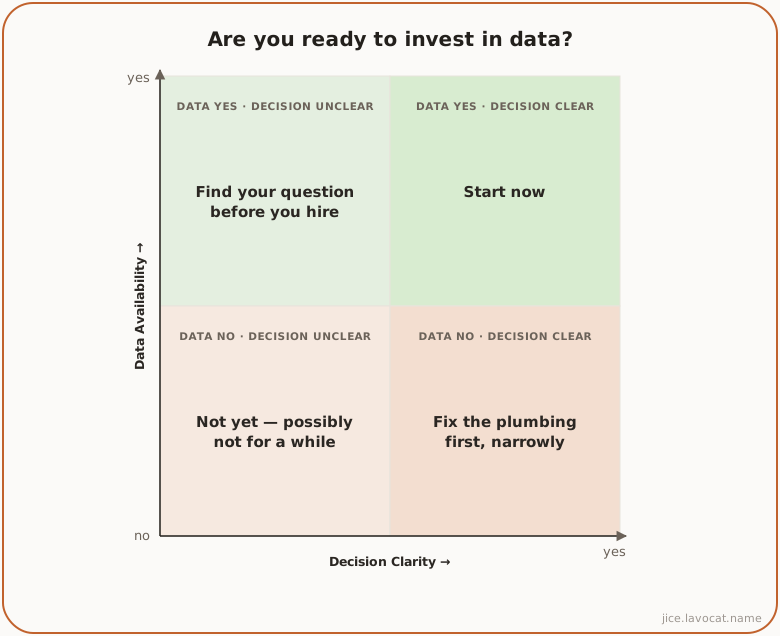
We’ll detail this resolution framework in the following sections. I’ll discuss the four situations where your Company could be right now. If you are the CEO, or CTO and plan to build the first Data Team, this quick overview might help you.
Why size and industry aren’t the real gate
It’s tempting to use company size as a proxy. Surely a 200-person company is more “ready” than a 20-person one. However, small tech companies would probably be ready early on (a 4-people SaaS might invest from day one) while brick and mortar ones should probably consider this when they get bigger. Different businesses become data-ready for different reasons, and at different stages. In the data foundation section, we’ll briefly approach the concept of “Data Maturity”, but this will get covered in more depth in a followup piece.
Reversly, industry type alone is also not enough. It’s tempting to assume that digital-native companies should have a Data Department from the founding date, while physical, traditional businesses might never invest in this field. But a car repair shop with clean data on jobs, parts, customers and delivery times may be much more “ready” to invest in data than a small software company whose data is scattered across a handful of tools, none bringing valuable vision on the business.
What actually separates them isn’t the industry. It’s whether the two conditions above are met: they have useful operational data to work with, and there are important business decisions that better data can actually improve.
The leverage question: would anyone actually act on it?
This is probably the question that hurts the most, which is why I ask it in the very first meeting with my customers: if you had the capability to get reliable answers and insights about your business, what would actually change? What would you try to optimize, and are your teams ready to act on what the data might tell them?
Robert Ardell’s guide to hiring a Head of Analytics frames it as two gates a company has to clear before opening that role. The first gate: does someone currently own the decisions this hire would inform, and are they ready to change how they operate if the data suggests they should?. That second part is easy to overlook. What happens when the data reveals something uncomfortable? Are your teams ready to hear it? And, more importantly, to act on it?
This may require some coaching and alignment before you hire. Your team needs to understand that data isn’t there to prove that someone was doing something wrong. Its purpose is to help the business make better decisions and improve over time. If people feel that analytics is being brought in to judge their work, they’ll naturally become defensive, and that resistance can become a significant blocker.
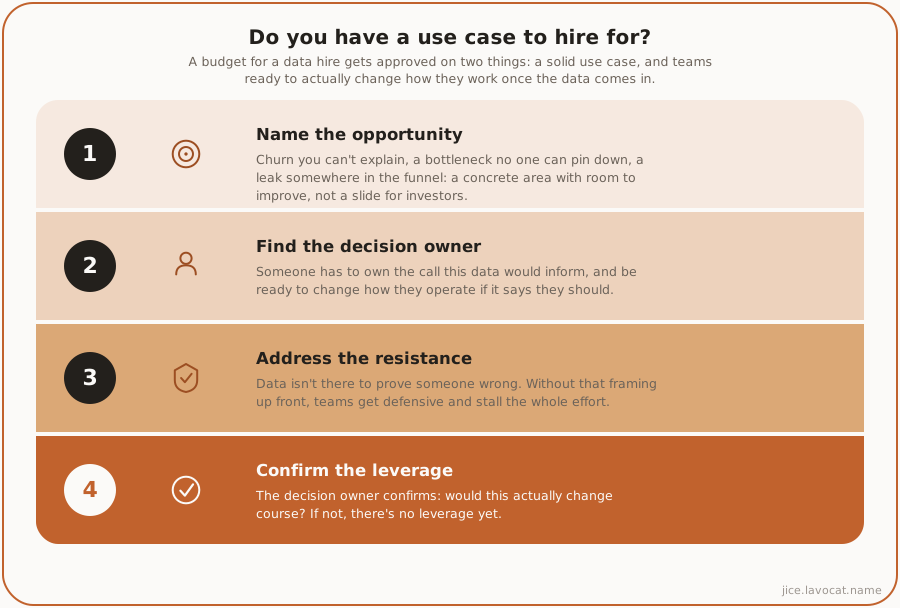
Yanir Seroussi makes a similar point in his older post, “You Don’t Need a Data Scientist (Yet)”: before you hire, you should be able to name the problem you’re trying to solve. Maybe customers are churning and you don’t know why. Maybe your operations team spends hours every week figuring out where things are getting stuck. Maybe you know conversion is leaking somewhere in the funnel, but you can’t pinpoint where. Those are reasons to invest in data (not “We should have some dashboards for the investors”).
If you can’t point to a decision that better data could improve, you may not be ready to hire yet. The good news is that, if you’re reading this, you probably already have a good enough understanding of your business to find one. Take a step back, look at where decisions are currently made with too little information, and spend some time finding the use case where better data could create real leverage.
The foundation question: do you actually have the data?
The second criterion to check before you hire is much more basic: are you actually capturing the information your business generates?
Orders, tickets, transactions, customers, projects, deliveries,… whatever the important building blocks of your business are, there should be some record of them. Logging activities as they happen and keeping a history of your operations is the starting point of your relationship with data. If nothing is being recorded, there is very little for a data hire to work with.
You probably already have some financial or banking data, but that’s only a starting point. And while AI and LLMs are making it easier to extract structured information from emails, documents, and other unstructured sources, the fundamental requirement remains: you need to be capturing something in the first place.
Your first structured data doesn’t need to be clean, centralized, or technically impressive. Spreadsheets, disconnected tools, a system someone half-trusts: all fine, as long as the underlying facts are actually being captured somewhere. What a data hire can’t do is make up numbers that were never recorded in the first place.
If your business isn’t tracking the basics yet, that’s the project to fund first, on its own, before a Head of Data role makes sense at all.
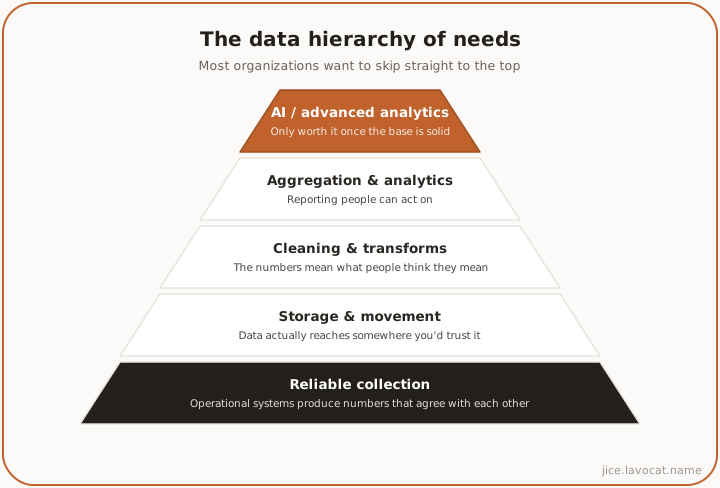
The important thing is to build these layers in the right order: reliable collection first, then storage and transformation, then analytics, and only then advanced analytics or AI.
Monica Rogati’s “The AI Hierarchy of Needs” is a useful illustration of this principle. You can’t build reliable analytics on top of data that isn’t being captured reliably.
The technologies will vary from business to business, but the sequence matters: first make sure the facts exist, then make them usable, then extract value from them. Cleaning and structuring that raw input is exactly the kind of work your first data hire can take on.
Four situations, and what to do in each
Put the two questions together and you get four positions.
Leverage AND Foundation
You’re ready to start. This is the point where a data function can create immediate value. The next step is to define the first few high-impact use cases, assess the current data landscape, and turn them into a pragmatic roadmap. This is where a fractional Head of Data can help you decide what to build, what to fix, and what to leave alone before committing to a permanent team.
Leverage But No Foundation
Build the foundation first. You already know where better data could change the business, but you don’t yet have enough reliable data to act on those questions. Start by identifying the minimum data you need to capture and put the right instrumentation and pipelines in place. This can often be a focused engineering project before you need a broader data function.
No Leverage But Foundation Are OK
Don’t build a data team yet. Having data available doesn’t mean you need someone to analyze it full-time. Instead, look for the business decisions where that data could eventually create leverage. In the meantime, keep the foundation healthy and avoid building dashboards, models, or infrastructure without a clear use case.
Neither Leverage Nor foundation
Focus on the business first. There’s no strong reason to invest in a data function yet. Start capturing the operational information that matters, but keep it simple. As the company grows, pay attention to the decisions that become harder to make without better information. That’s when it becomes worth revisiting both sides of the matrix.
What about autonomous Data Teams?
One thing is worth considering before we close: everything above assumes that a human is the one looking at the dashboard, asking the question, and turning the answer into an action. That assumption is becoming less certain.
As LLM-powered self-service analytics matures, non-technical stakeholders can increasingly ask questions directly against a company’s data and get grounded answers in plain language. If the cost of getting an answer drops dramatically, the threshold for deciding when it’s worth to invest in a data department may change too.
“Autonomous Data Teams” is a big enough topic to deserve its own article and it’s next on my list.
For now, though, I don’t think the fundamentals change. Whether the person asking the question is an analyst, an executive, or an AI agent, two things still need to be true: you need data you can trust, and there needs to be something real riding on the answer. Everything else comes after that.
References
- Monica Rogati (2017, Hacker Noon) — The AI Hierarchy of Needs. Source of the “hierarchy of needs” framing for data readiness — reliable plumbing before advanced analytics.
- Yanir Seroussi (2014) — Data’s Hierarchy of Needs. Earlier write-up of the same pyramid concept, tracing it to Jay Kreps’ LinkedIn engineering post “The Log.”
- Yanir Seroussi (2015) — You Don’t Need a Data Scientist (Yet). Five gating questions before a first data hire; source of the “specific problem” and “leadership commitment” tests used above, and of Eric Colson’s dissenting comment.
- Robert Ardell / KORE1 (2026) — How to Hire a Head of Analytics: 2026 Guide. Source of the “two gates” framing and the Denver/Charlotte cautionary anecdotes referenced above.
- Saad Amrani Joutey / Fygurs (2025) — The 5 Levels of Data Maturity. Source of the “Level 2 trap” and the point that higher maturity isn’t a universal goal regardless of company size.
- Toby Lloyd / Mamba Strategic (2026) — Do I Need a Chief AI Officer? SME Guide. Structural analog for rejecting a pure revenue/size threshold in favor of a complexity-based trigger; informed this post’s framing even where not directly quoted.