
Buying an app on Acquire.com sounds simple: find a listing, check the numbers, wire the money. However, I realized that in practice, roughly two-thirds of what’s listed wasn’t worth touching for me, and even the good third would hide problems that you won’t see until you start digging. In this post, I’ll explain how I built a simple acquisition pipeline to run this search, the legal timing challenge that almost stopped my first deal, a fraud signal I almost missed on another listing, and why the first deal fell through anyway.
Looking for an App to Buy
This is the promised follow-up to the first post in this series, where I explained the broader story of leaving my job to build Amani Labs.
I started looking at Acquire.com in May 2025, while I was still working at 52 Entertainment. A friend of mine was also browsing the platform, independently and mostly out of curiosity, and we started comparing notes on the listings that looked interesting.
What’s actually on Acquire.com is quite a mixed bag.
Roughly a third of the listings were apps I wasn’t going to touch on principle. There were QR-code readers, spycam detectors, blood-pressure-via-phone-camera apps, fart simulators and similar things. Some of them probably had a real technical component, but the way they were marketed and monetized relied on dark patterns that I didn’t want to be involved with.
Another third were “AI-based” apps. In most cases, these were vibe-coded wrappers around an existing LLM or image-generation API. They had been built very quickly, with seemingly little thought about what would happen to the unit economics if users actually started using the product at scale.
And then there was the last third. These were the interesting ones: genuine businesses, often built by solo founders, usually in the $15,000–50,000 range. Someone had found a niche, built something that worked, and was now looking for an exit to move on to something else.
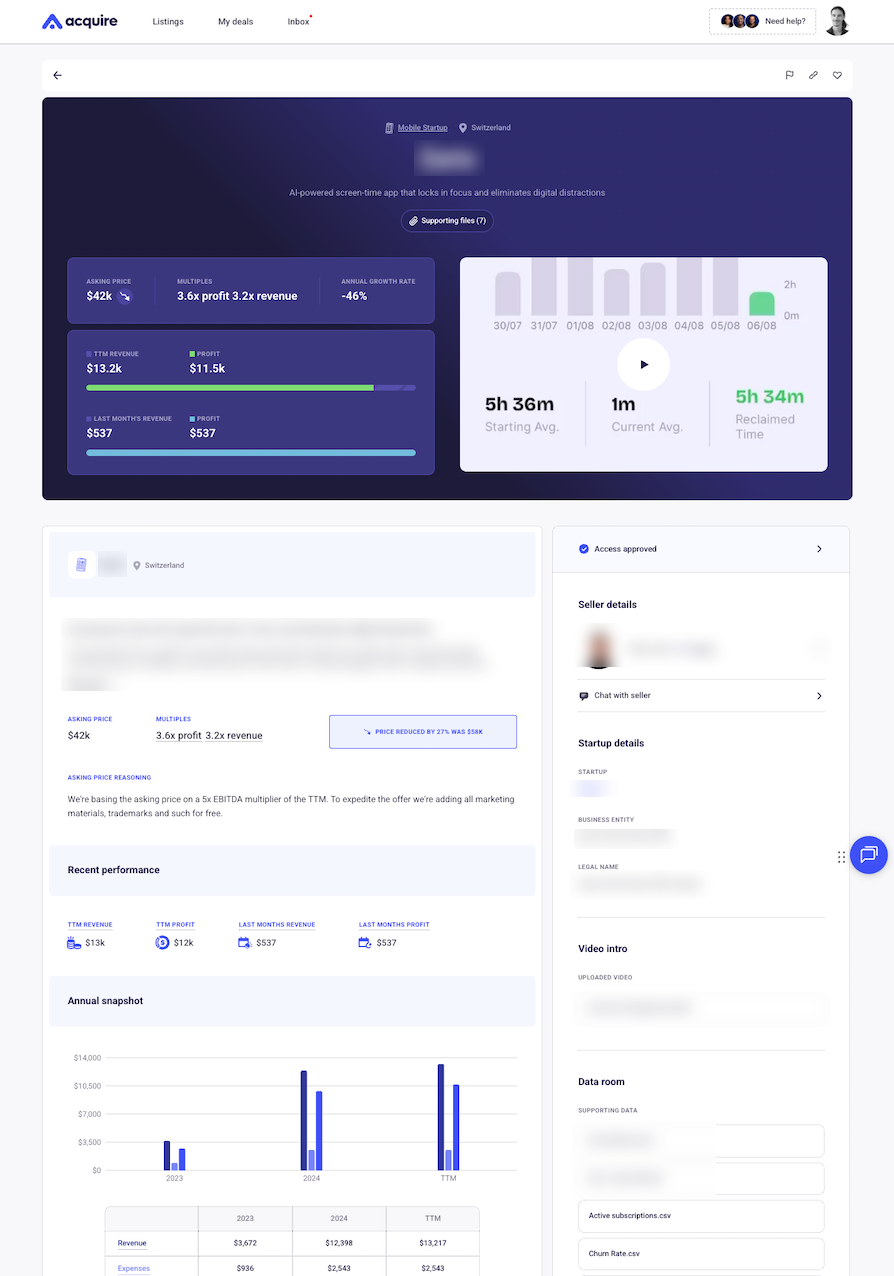 An example of a Acquire.com listing - A short description of the app is coming with metrics about the business
My search criteria were mostly budget and tech stack. I was specifically looking for apps built with multi-platform frameworks such as Flutter or React. So the technical filter was almost as important to me as the financial one.
On May 10th, I found one listing that matched both criteria: a masturbation-addiction prevention app.
It also happened to fit the mental-health thesis I had started to develop. I didn’t even know “masturbation addiction” was a recognized category before finding this listing.
To contact sellers on Acquire.com, you need a paid subscription. At the time, it was $390 a year. I subscribed and started building a simple pipeline to actually run the process.
Building a Pipeline From Scratch
In a traditional M&A process, buyers and sellers communicate through something called a “Data Room”. I didn’t need anything that formal for deals of this size, so I built a simplified version myself.
The idea was to have a process I could repeat across several sellers at the same time:
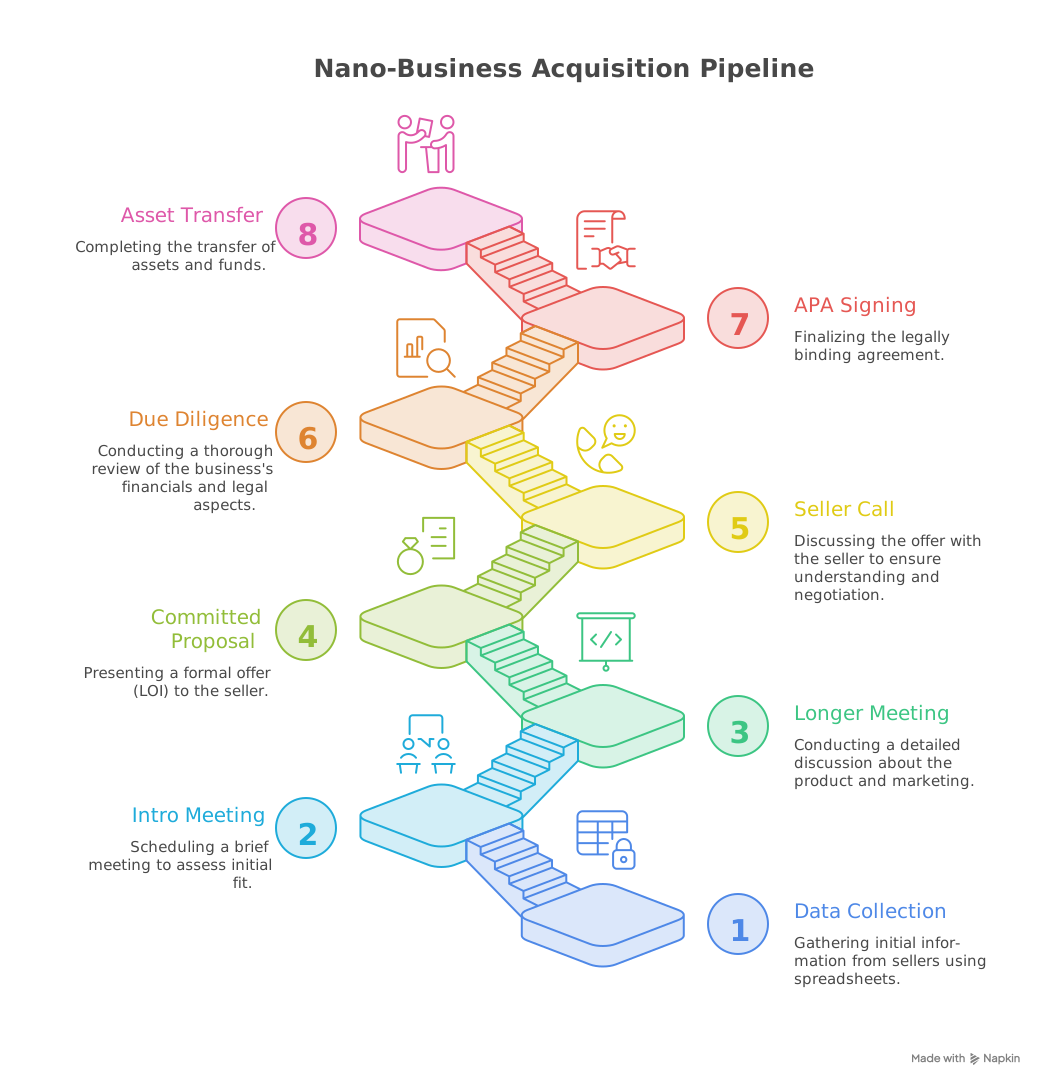
Initial data collection, using a spreadsheet. I asked for contact information, financial metrics, tech stack, reason for selling, legal and IP information, marketing channels, and a few other things.
Intro meeting, usually scheduled within a week of getting the spreadsheet back.
A longer meeting, if there was a fit. This covered the product and marketing side in more detail. I wanted to see a quick code walkthrough, understand how the founder had been growing the app, and get a screen-share of the store consoles. The last part was important: I wanted to make sure the seller actually owned the app and that the revenue numbers were real.
A committed proposal within two weeks, if the project still looked interesting. In standard M&A terminology, this is a Letter of Intent, or LOI.
Before making the LOI official on Acquire, a call with the seller to go through the offer directly. I wanted to understand their reaction, answer questions and make it clear that the number was still negotiable. Acquire provides a standard LOI template. Signing it isn’t binding, but it gives the buyer exclusivity.
Due diligence, once the offer was accepted after one or two rounds of negotiation. In a larger transaction, this can take months. At this deal size, I deliberately wanted to keep it short. Most of these founders already have another project waiting, and if you drag the process out for too long, you risk losing the deal simply because the seller gets tired of it.
The Asset Purchase Agreement (APA). Again, I used the Acquire template. This is the first legally binding step of the process.
The actual transfer. This part is more tedious than it sounds. Wiring a large amount of money from a personal bank account, especially in a foreign currency, can take several days. On the seller’s side, transferring the business is also more than just giving you the code repository and the app-store account. There are usually Figma files, social accounts and various tools that need to be transferred too. It is better to make a list before starting.
There are also a few things that can be negotiated in the LOI.
The payment structure is one: cash up front, seller financing, or an earnout. The timeline is another: one lump sum or smaller recurring payments. And finally there is the support expected after the sale, from a clean handover to ongoing help running the business.
I was running this process in parallel across several sellers, not just this one.
The side conversations were actually very useful. I was getting a real education in how indie app founders get visibility. Some relied mostly on social media, such as X, Instagram or TikTok. Others were doing Reddit stealth marketing. Only a few were using paid acquisition.
I Couldn’t Buy It Yet
When I actually started drafting the LOI, I ran into a problem that had nothing to do with the app.
I wanted to hold the acquisition inside a proper company. The problem was that, in early May, I was still employed at 52 Entertainment and didn’t have the legal right to run an outside business activity.
At the same time, I wanted to preserve my eligibility for French unemployment benefits. This is a system that has a reputation for being generous, but I learned firsthand that it had become considerably stricter.
So I couldn’t just create a company overnight and put the acquisition inside it.
I proposed something else to the seller, fully transparently.
While I was sorting out leaving my job and setting up the company, I would invest a specific budget in user acquisition for his app. He would keep all the resulting revenue. I wasn’t buying anything yet. I was simply spending money on his behalf.
It was a genuine double win.
First, it gave me the time I needed to leave my job properly and set up the company. But it was also another form of due diligence that I wouldn’t normally have had.
I could test the marketability of the app with real money.
Could we scale the app through paid acquisition? Or was the product still not good enough and needed more work before it made sense to spend money on growth?
That was something we could actually test instead of trying to guess from a spreadsheet.
The Deal I Didn’t Buy (Red Flag)
This idea of doing a marketability test before committing to an acquisition also saved me from a much worse mistake on another deal.
The vibe-coding era means that Acquire.com gets a steady stream of new listings. At the time, there wasn’t much quality review on the platform either.
The obvious scams are relatively easy to spot. An unfinished Lovable site or a $99 CodeCanyon template presented as a real product isn’t very convincing. Those don’t usually find buyers.
The more difficult case is a legitimate-looking app with boosted traffic.
At this deal size, this is surprisingly hard to detect. A seller can spend some money on Apple Search Ads or Meta, stay below the thresholds that market-intelligence tools look at, and make the traffic look much better than it really is.
In other words, someone can spend money on unprofitable campaigns simply to make the numbers look good before selling the app. I found something that looked very much like this with a second app, also in the addiction space.
The product itself looked nice. There was an active community and the trend line had been going up quite strongly over the previous few weeks.
The seller’s explanation for selling was that his team had moved on to another project… That didn’t make much sense to me. If the numbers were really improving that quickly, why would you walk away now?
So I slowed things down instead of chasing the deal.
I proposed the same marketability test I had offered to the other seller: I would put some paid acquisition budget into the app, and he could keep the revenue.
He refused.
That was probably the clearest signal I could have asked for.
There isn’t much reason to refuse free money unless the test could expose something you don’t want the buyer to see.
I kept the deal at a standstill long enough that the ad spend apparently stopped. The seller eventually told me that he had sold the app to someone else, and we stopped talking.
I still have access to the project’s Superwall account, which was never revoked. So I have been able to watch what happened afterwards.
The app went from roughly $1,000 a month in revenue, as discussed back in July 2025, to around $100 a month a year later.
I’m quite happy I didn’t buy it.
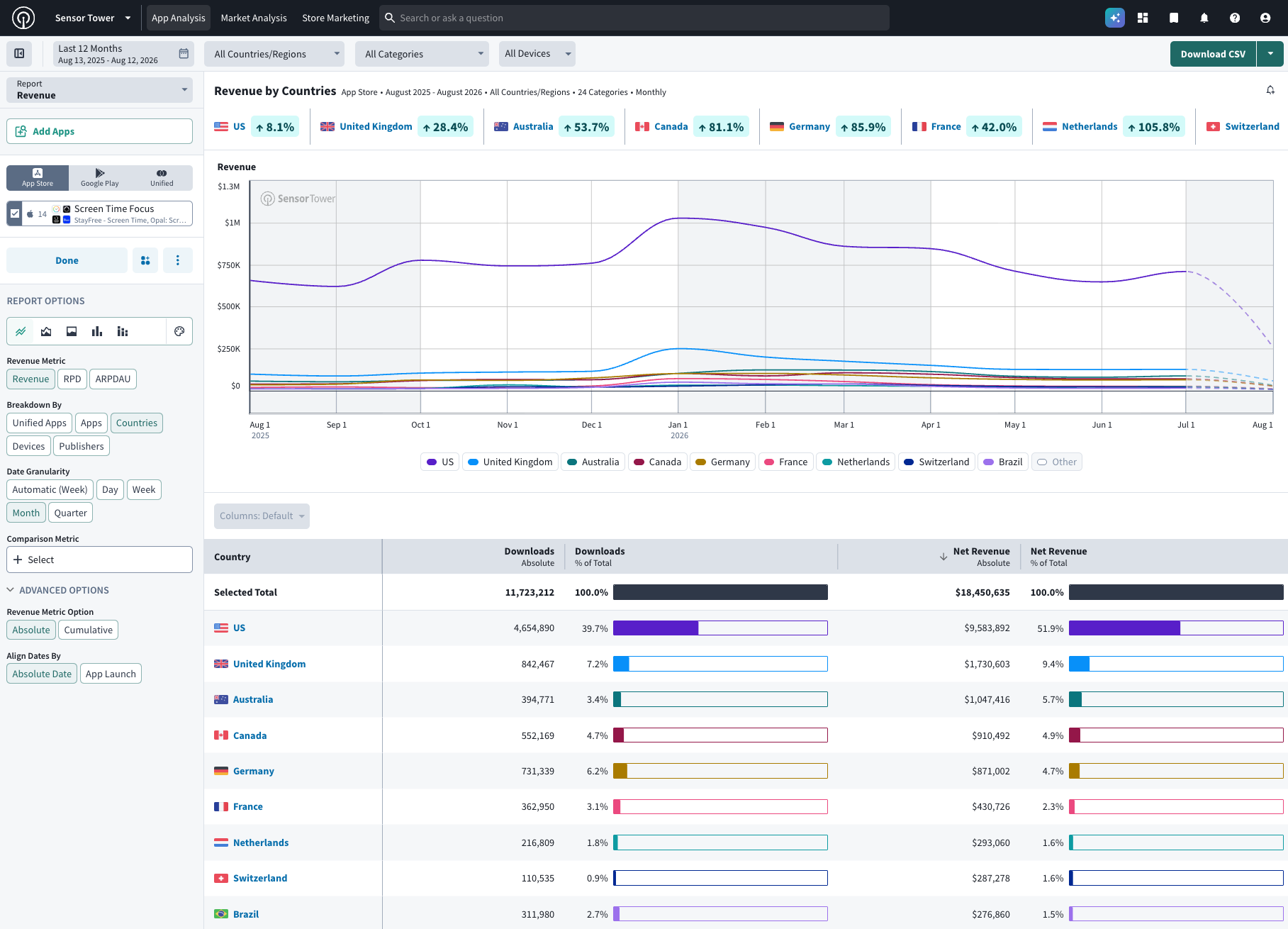
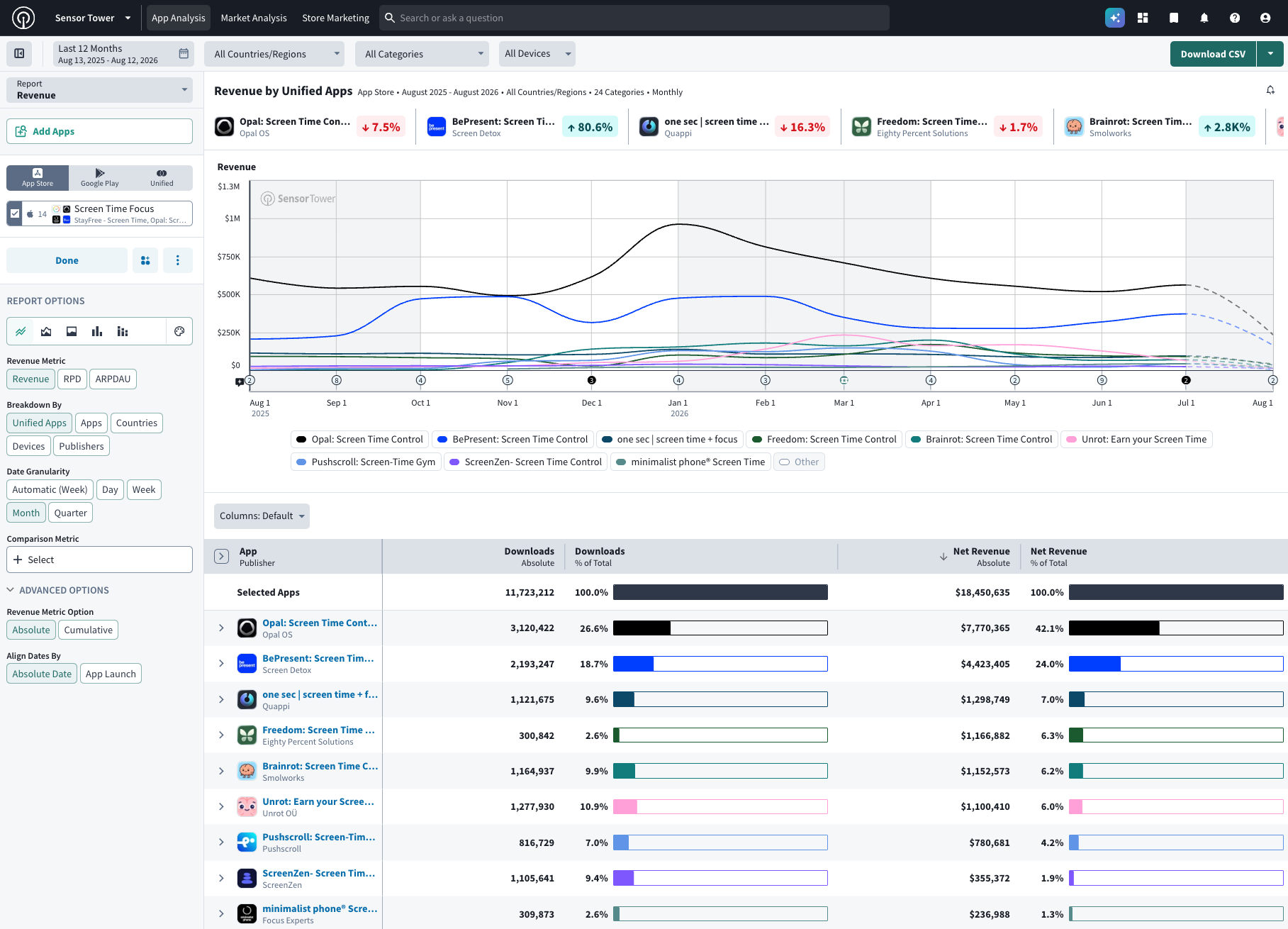
None of this would have been possible without Sensor Tower, which I used to map competitors, estimate the addressable market and check the biggest geographies before spending too much time on a candidate.
 TODO: caption — describe what this screenshot shows
 TODO: caption — describe what this screenshot shows
I’ll probably write a separate post about this at some point, because it became a surprisingly important part of the process.
Why the First Deal Didn’t Happen
Back to the original deal.
About two weeks into the user-acquisition arrangement, the seller came back to me with some unexpected news.
He had changed his mind.
He wanted to keep running the app himself. He said that he could see the potential in it again.
I think this happens more often than it looks from the outside.
After months without much growth, it is easy to start wondering whether you are the problem. Maybe you’re not really a founder. Maybe you just built something that nobody wants.
Then you look at social media and see people talking about making millions from their app six months after launch.
I’m not saying those stories never happen. But there are also plenty of consultants and tools making money by selling that dream.
If you’re not doing five figures a month, it can become difficult to feel that you’re doing something legitimate.
During the process, we had spent quite a bit of time together looking at competitor tactics and growth ideas. It was basically founder-to-founder.
When we started talking, he told me that he had been feeling depressed about the business.
When he eventually decided to pull out of the deal, he sounded genuinely re-energized about it.
So, for him, I think the experiment worked.
For me, it was disappointing, but not a big problem. I hadn’t even started forming the company yet, so there wasn’t much to walk away from.
If anything, it was almost a relief.
We parted on good terms, and I continued taking intro calls with other sellers.
A few weeks later, that same process led to the acquisition that actually happened.
But that’s a story for the next post.